

If You Think Good Design Is Expensive
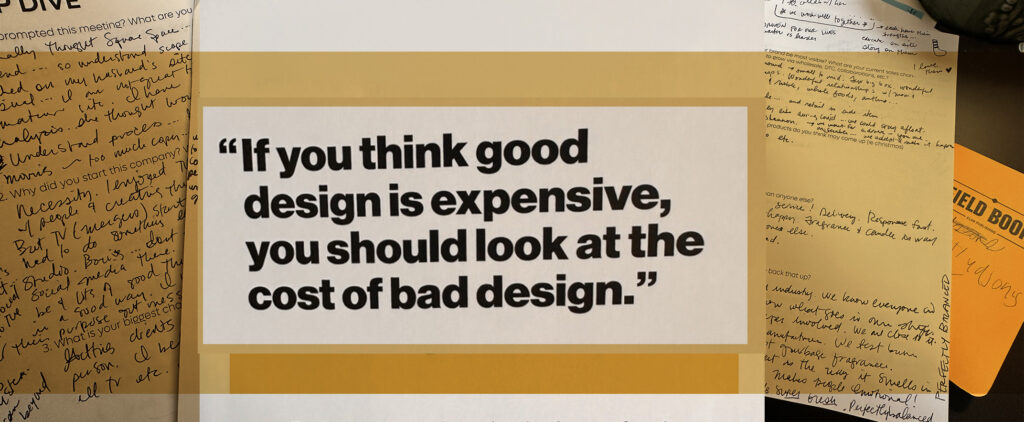
— Dr. Ralf Speth, former CEO of Jaguar Land Rover
It’s common to feel surprised by the cost of good design.
You see a number and instinctively compare it to other options. Faster options. Cheaper options. Things that promise to get you to the end result with less friction.
That reaction is understandable. Especially when the value of design feels abstract at the beginning.
But over time, you start to notice where bad design actually shows up.
Where the Cost Really Appears
Bad design rarely announces itself immediately.
It often looks fine at first. Serviceable. Close enough. Something you can live with while you focus on other things.
The cost shows up later.
It shows up in having to explain your business over and over again. In a website that feels almost right but never fully lands. In a brand that doesn’t quite hold together across different uses or stages of growth.
Often, this happens when things move too quickly.
Strategy is skipped. The deeper questions are rushed past. Decisions are made without a clear framework to support them. The work exists, but it doesn’t carry its weight.
At first, that doesn’t feel expensive.
The Hidden Cost of Moving Too Fast
The real cost of bad design is rarely the initial price.
It’s the accumulation.
It’s the small fixes. The constant adjustments. The sense that something still isn’t quite right, even after you’ve already “finished.”
It’s the energy spent compensating for what the design isn’t doing for you.
More often than not, bad design costs you twice. Once in what it fails to do, and again in what it eventually takes to undo and rebuild.
What Good Design Actually Buys You
Good design is not about polish for its own sake.
It’s about clarity. About alignment. About making decisions that hold up over time.
When design is built on a clear strategy, it does quiet work in the background. It helps people understand you without needing extra explanation. It supports growth instead of getting in the way of it.
That kind of design tends to last longer. Not because it’s trendy or perfect, but because it was built with intention.
A Different Way to Think About Cost
The question isn’t whether good design is expensive.
The better question is what it costs you when the design doesn’t do its job.
When you look at it that way, the value of slowing down, digging deeper, and building something that actually fits becomes much clearer.

be the first to leave a comment